


FILMAR, ADG and DACAP Received Training from DAC and ARGENTORES
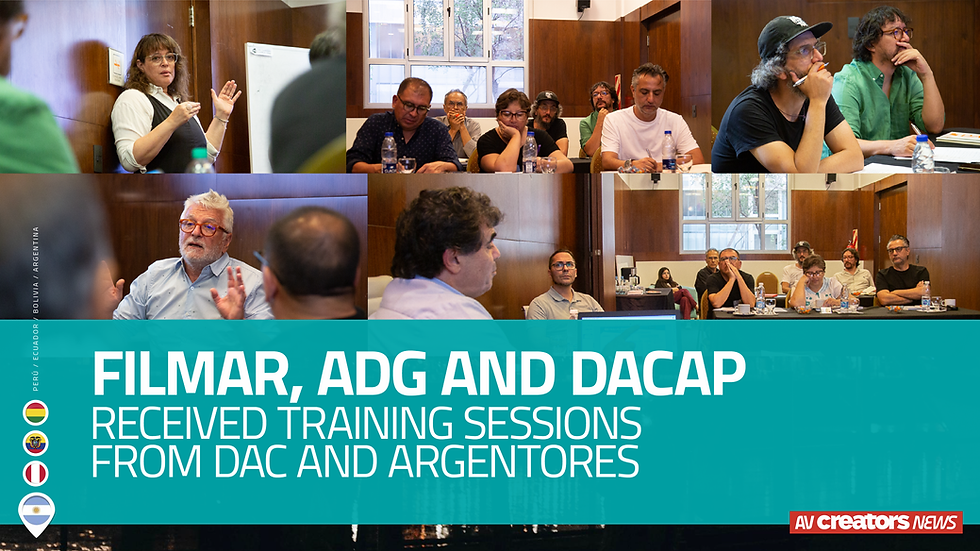
Representatives of FILMAR (Bolivia), ADG (Ecuador) and DACAP (Perú) visited Argentina to receive training in collective management of audiovisual rights from DAC and ARGENTORES. The exchange, promoted by AVACI and FESAAL, aims to strengthen the institutional structures of member organizations and consolidate a network of audiovisual authors equipped with concrete tools to defend their rights and establish collective management societies in their home countries.
As part of their goals of international cooperation and institutional strengthening, DAC and ARGENTORES held a series of training sessions in Buenos Aires for representatives of audiovisual authors’ organizations in the region that are in the process of consolidating themselves as collective management societies.
During their stay, delegations from FILMAR (Bolivia), ADG (Ecuador), and DACAP (Peru) took part in intensive technical, legal, and administrative training sessions aimed at understanding the full operation of these entities, from repertoire management to rights collection and distribution systems.
Peru: expanding the repertoire and building legitimacy
The DACAP delegation traveled headed by its president, Franco García Becerra, and vice president, Rodrigo Moreno del Valle, both Directors and Screenwriters. The institution is currently going through a key stage: although it already operates as a non-profit association, it is still working to achieve the representativeness required to formally establish itself as a collective management society before Peruvian authorities.
One of the main challenges identified is the lack of awareness within the audiovisual community regarding author’s rights in the local audiovisual sector, which results both in difficulties attracting new members and in a certain distrust toward royalty administration. In addition, many Peruvian directors are already affiliated with foreign societies, which complicates the construction of their own repertoire.
In this context, the training at DAC and ARGENTORES proved essential to gain an in-depth understanding of how a collective management society operates and to be able to clearly convey that information to their community. “It allows us to tell our future members how their money would be managed,” they explained.
—Unlike societies in other countries, DACAP emerged as an entity specifically for Audiovisual Authors. How does this structure interact with the rest of the Peruvian audiovisual sector, and what kinds of articulations do you consider necessary to consolidate a comprehensive management system?
FGB: The collective management society has one main objective, which is something we learned in these training sessions: the defense of author’s rights and the collection of remuneration rights. Other trade organizations do not deal with this issue, but rather defend representation in other aspects. The way we can articulate with these other organizations —which is very positive— is that we can now speak directly with a group that can socialize the issue and explain that they have a right, that in the future they may receive remuneration for making their films, and that this does not affect the activities they may already be developing independently. What we do is more of a unifying effort for Authors. The same applies to the relationship with other collective management societies, such as those for actors or producers. Fortunately, in Peru the law allows for several collective management societies to exist and collect remuneration rights. In other countries, these societies coexist and cooperate positively. I believe that is one of our main goals.
RMV: Existing associations or guilds include all audiovisual sectors. And all of them are also represented by some union, such as SINCA (Workers’ Union), but SINCA does not consider us Directors to be technicians, so it does not support us. I think it is a key difference to have Directors and Screenwriters, who do not have a specific association. Since we are an association that protects author’s rights and royalty collection, it can also provide social benefits that no union will give us, or support not covered by law because we are not considered audiovisual technicians in our country.
Another key aspect was understanding the international scope of the system: being part of FESAAL and AVACI means not only representing local authors, but also administering a global repertoire through reciprocity agreements. This dimension significantly broadens the horizon of the future Peruvian society.
At the same time, the representatives stressed the importance of taking advantage of the debate generated by Peru’s new film law, which, although controversial, could help make the need to strengthen authors’ rights in the country more visible.
Ecuador: from civil association to collective management
In the case of ADG (Ecuador), the organization is at an early but strategic stage. Formally established in 2024 with 42 members, it is awaiting legal recognition, an essential step before requesting recognition as a collective management society before the competent authority.
Its representatives, Manolo Sarmiento and Tito Jara, both Directors and Screenwriters, emphasized that the process involves not only fulfilling formal requirements —such as having a repertoire and administrative capacity— but also building a foundation of knowledge and awareness within the Ecuadorian authors’ sector, where author’s rights have historically had little visibility.
In this regard, the training in Argentina was described as “opening the mind to countless possibilities.” The opportunity to learn in detail about systems for tracking works and distributing royalties —capable of identifying specific broadcasts across different media— demonstrated the level of development a consolidated collective management society can achieve.
They also highlighted the impact in Ecuador of the recent reinstatement of the Film Institute, after its elimination in 2020, which opens a new stage for audiovisual production, although still on a limited scale.
—What can you tell me about the new generations? How are they shaping up within Ecuadorian cinema? Do they have at least a minimal awareness of author’s rights, or does it feel very distant to them?
TJ: I have been a teacher for a long time, and I have a daughter studying film. And I’ve been thinking these days that this should be part of the curriculum, precisely so this situation does not continue. So that from their academic training onward they understand the rights they must exercise.
MS: There is no such awareness. I teach an author’s rights course at the University of the Arts, and I try to explain all this to them. At ARGENTORES we learned that there is a very strong theater culture in Argentina, and that they collect playwrights’ rights from all theaters. That surprised us because in Ecuador theatrical life is smaller, but this is not regulated. Theaters barely collect ticket revenue, but they do not distribute it to the author: the author receives nothing. Everything is reduced to the payment the producer gives you at the time the work is made. And that is where it all ends. It is as if the author says goodbye forever to their work at that moment. And here we realize that this is not the case: the author maintains a permanent connection.
Bolivia: consolidating the structure and advancing toward licensing
Representing FILMAR BOLIVIA, its president, producer Victoria Guerrero, and its finance secretary, Director Miguel Torricos, traveled to Buenos Aires for training. FILMAR is currently in a stage of institutional strengthening that began in 2021, with the goal of obtaining the license that will allow it to formally operate as a collective management society before SENAPI —the National Intellectual Property Service.
For its authorities, the training represented a turning point: it provided access to detailed information on concrete processes —from repertoire management to the implementation of technological systems— and enabled direct ties with the technical teams of DAC and ARGENTORES.
Among the next steps, FILMAR plans to move forward with the registration of works by its founding members, expand its membership base, establish a stable administrative team, and design a communication strategy aimed both at authors and users of audiovisual works.
In a country where collective management societies already exist in other sectors —such as music— but not in the audiovisual field, the challenge is to build a solid structure from scratch. “We are not alone,” they emphasized, referring to the support of FESAAL and AVACI, which is key to moving forward with greater confidence in this process.
They also stressed the importance of creating alliances among Andean countries going through similar stages, with the goal of strengthening one another and accelerating the consolidation of their respective entities.
An expanding network
The experiences of DACAP, ADG, and FILMAR reflect a growing regional process in which more and more organizations are moving toward the creation of collective management societies capable of guaranteeing remuneration for audiovisual authors.
Through the transfer of knowledge, technical support, and international coordination promoted by AVACI and FESAAL, a network is being consolidated that seeks to provide creators with concrete tools to defend their rights in an audiovisual ecosystem undergoing constant transformation.


Comments